MONOCULAR COMPOUND MICROSCOPE
MAKER:L. SCHRAUER
c.1885
MODEL: PHYSICIAN'S
MICROSCOPE (LATER MODEL)
AUTHOR: Barry Sobel
EDITOR: Joseph Zeligs
Please Click On Any Picture for a Larger Version
DESCRIPTION:
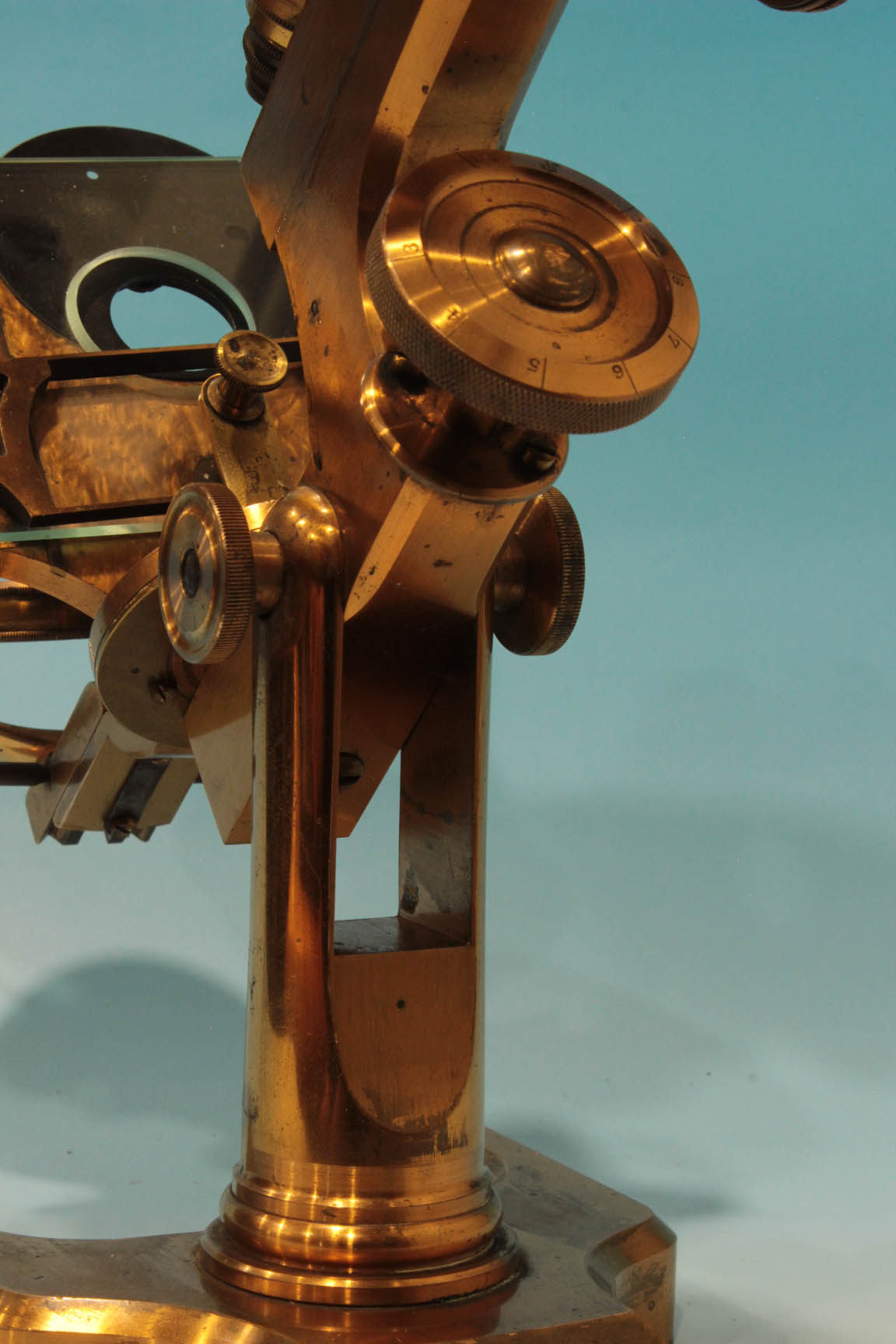
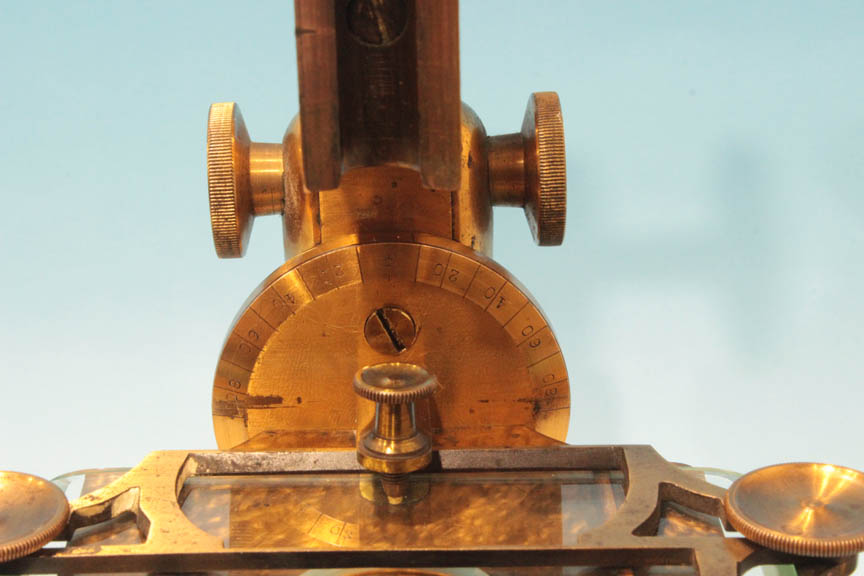
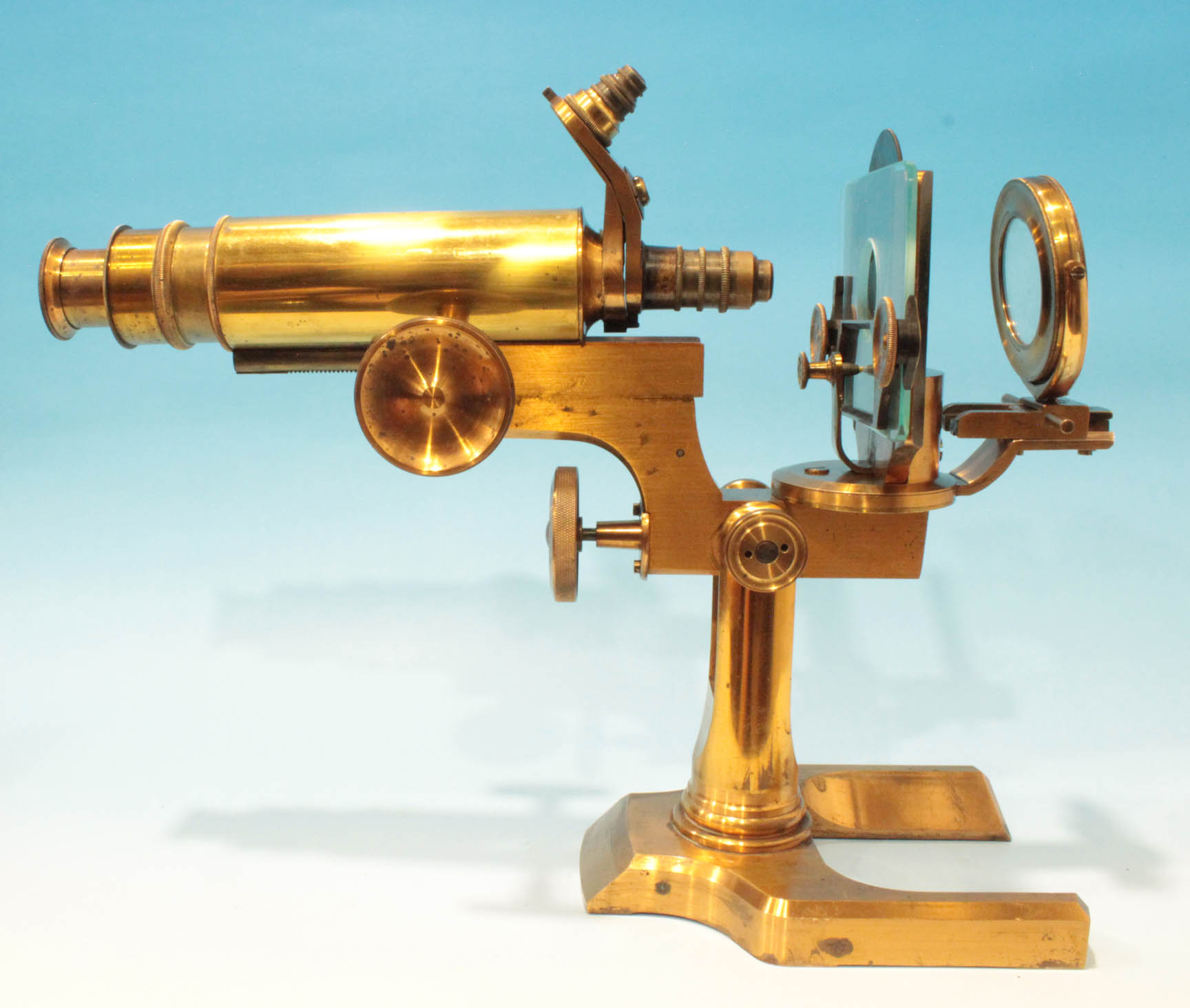
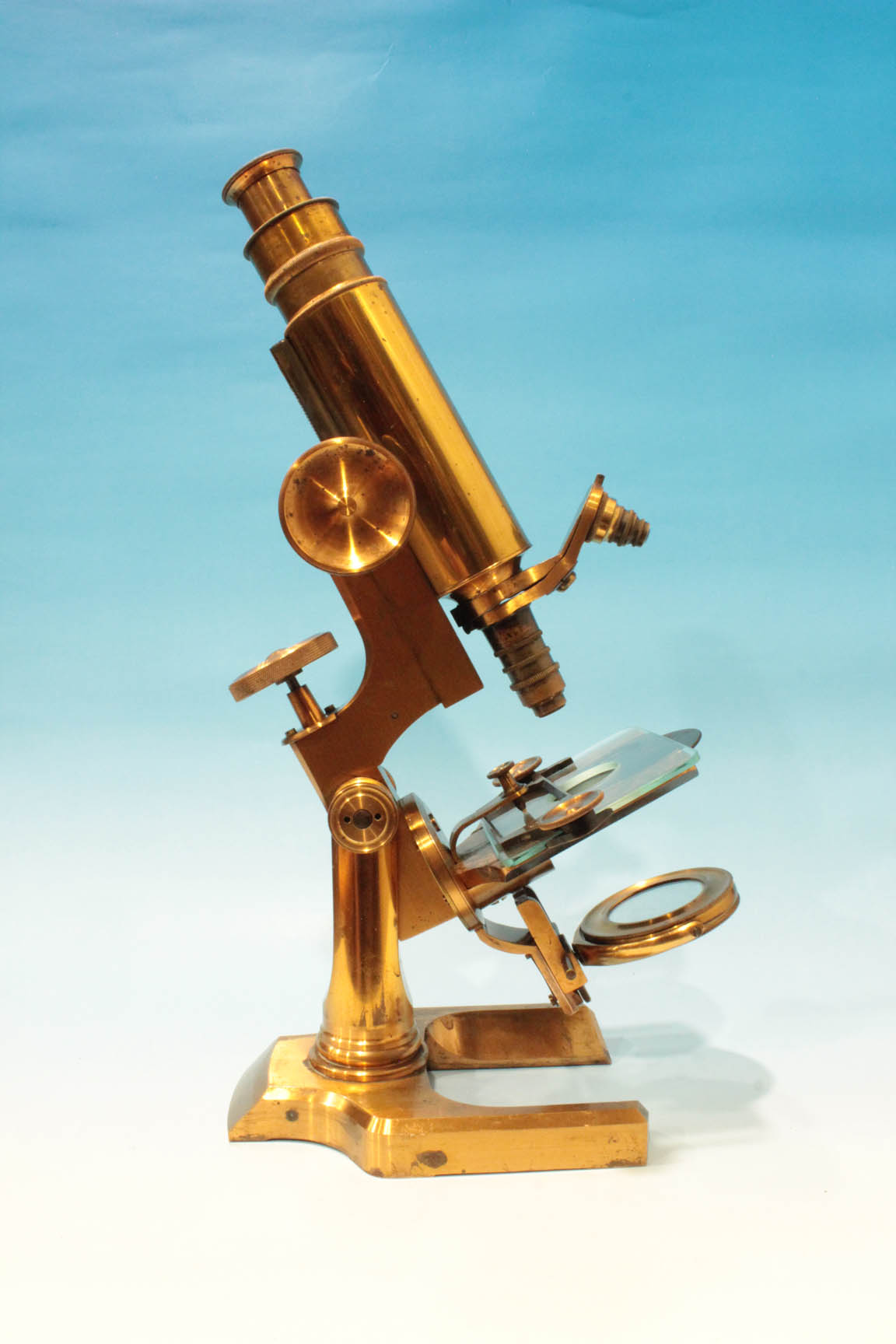
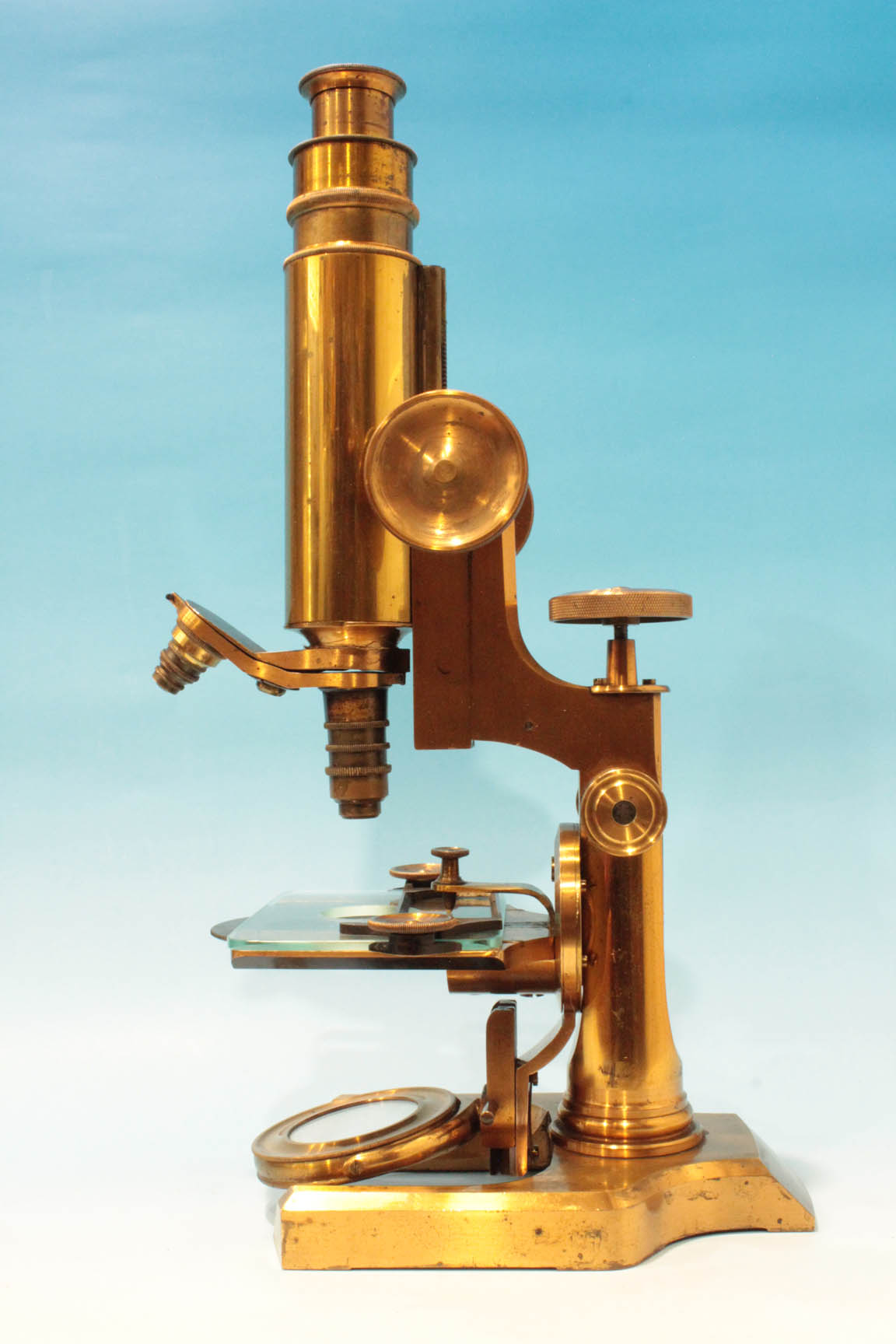
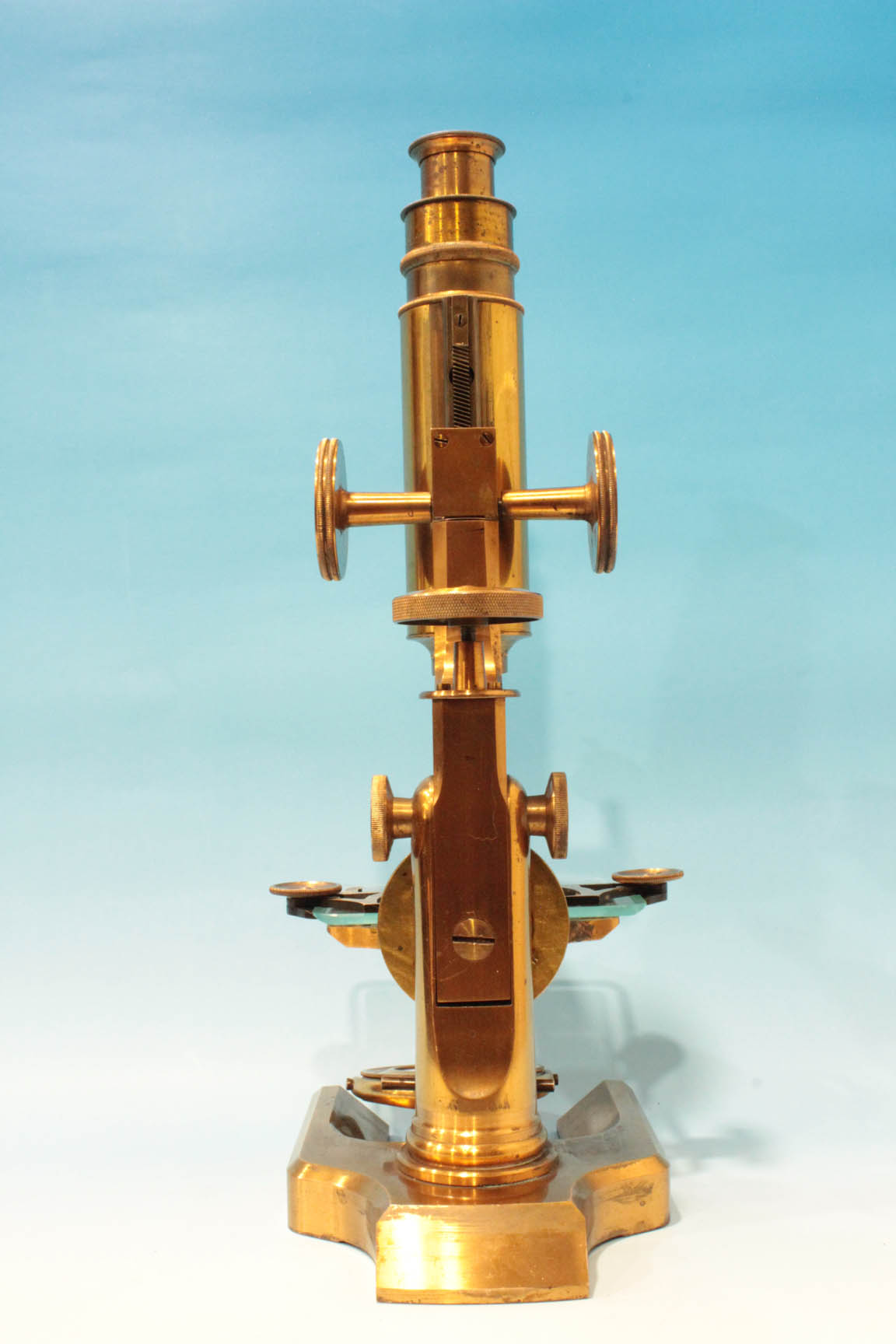
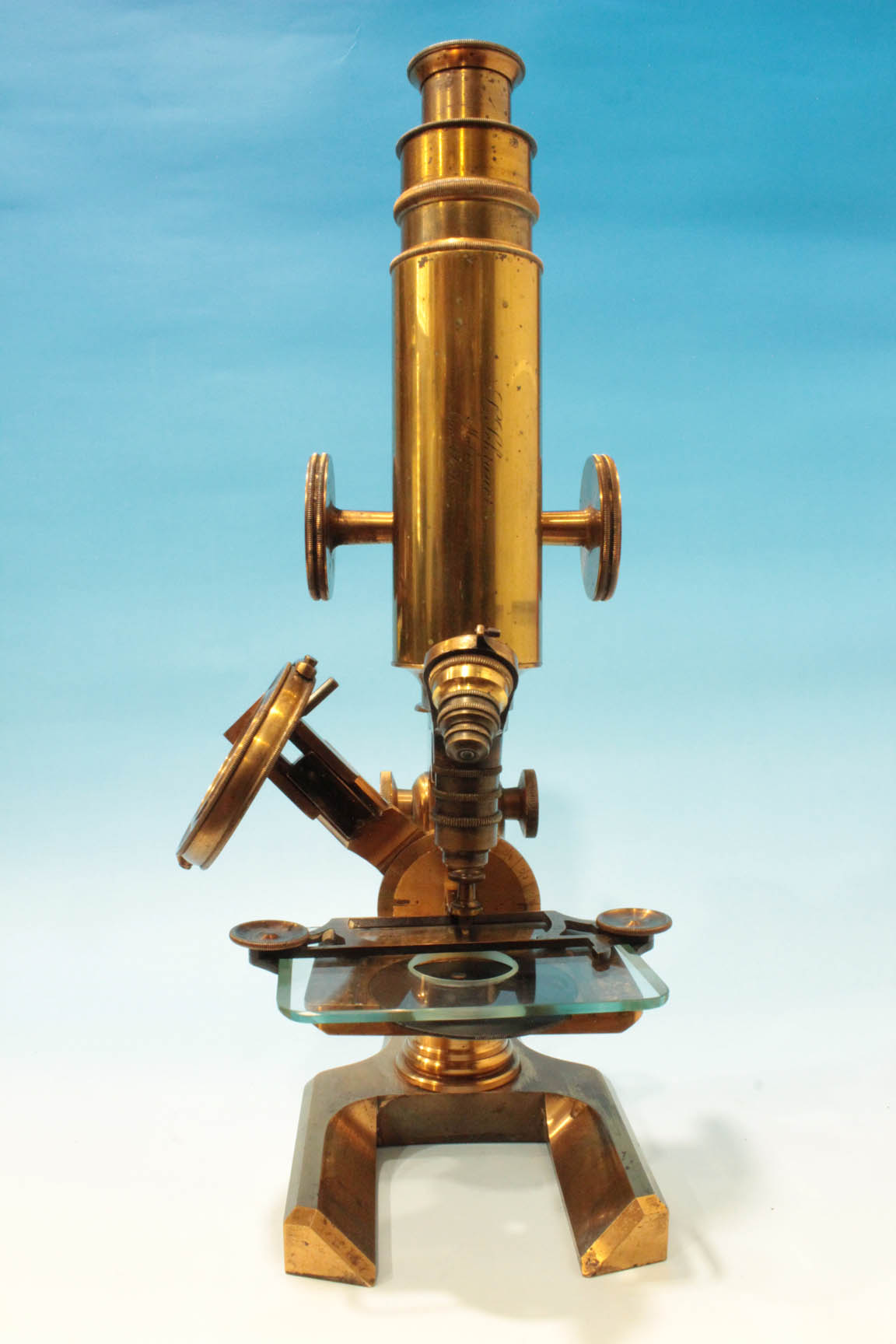
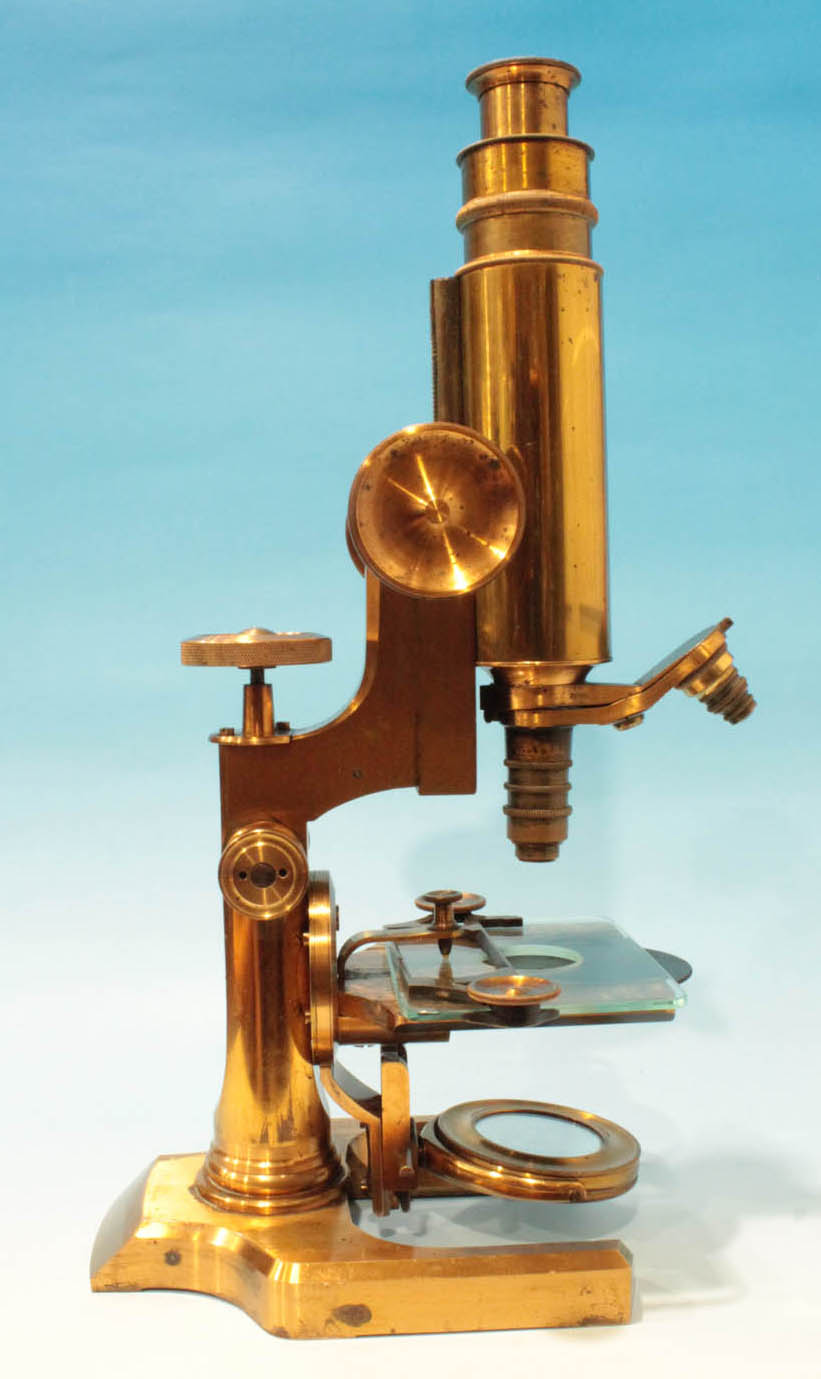
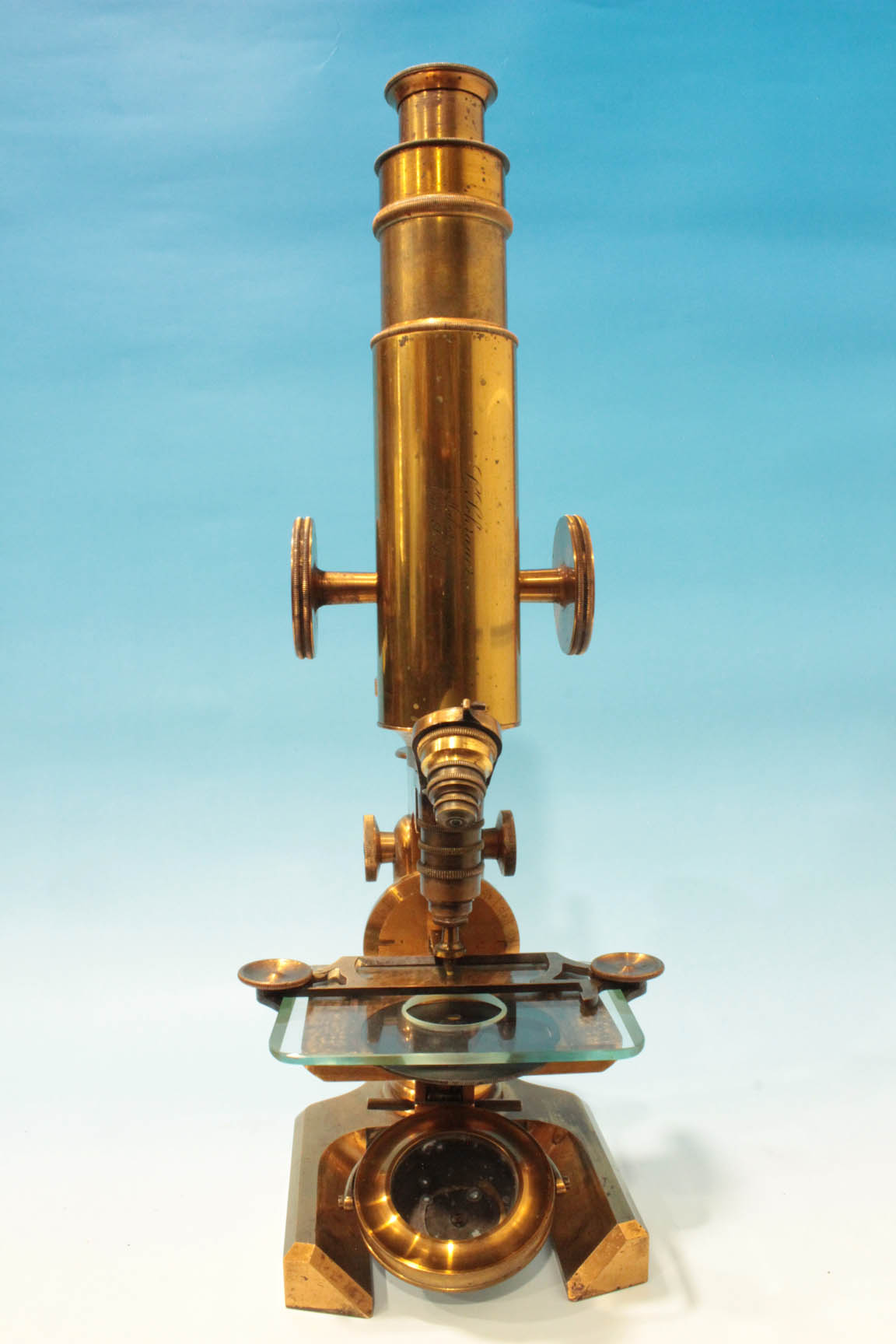
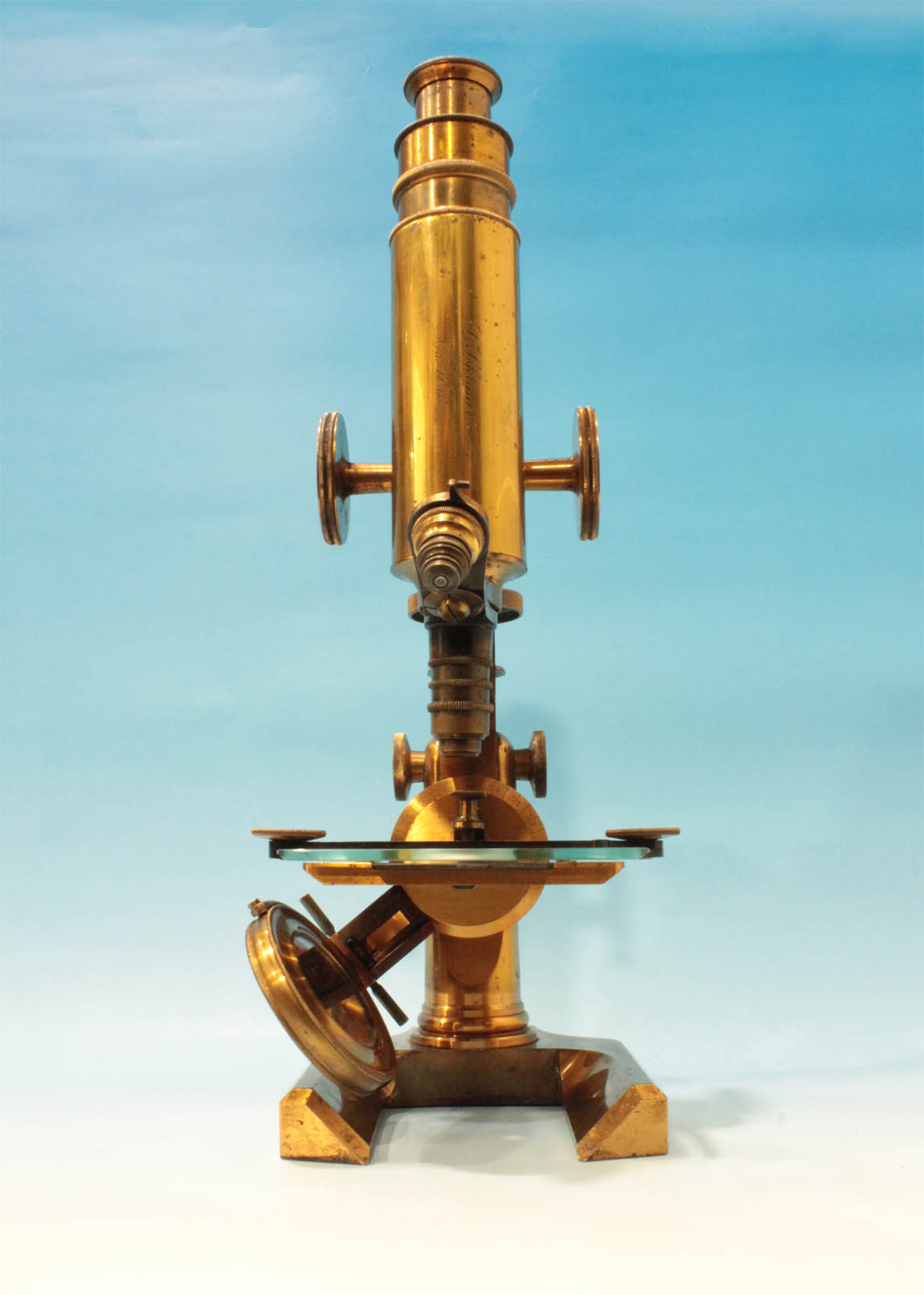
This is a compound monocular microscope by Leopold Schrauer. It arises from a horseshoe foot of the typical Schrauer form wherein the profile of the foot, as viewed from the front, has angled inner sides, instead of being squared off as in most horseshoe feet. Arising from the foot is a heavy single pillar which splits into two thin uprights and terminates in a joint which has knobs for controlling the pressure on both sides. The Lister limb extends below the inclination joint where the stage and swinging substage are attached.
The swinging substage features a mirror which has both concave and flat sides, and its gimbaled mount can be moved up and down the tailpiece on a dovetail mount. The swinging substage can be positioned above the stage for top lighting, and there are calibrations to mark its position.
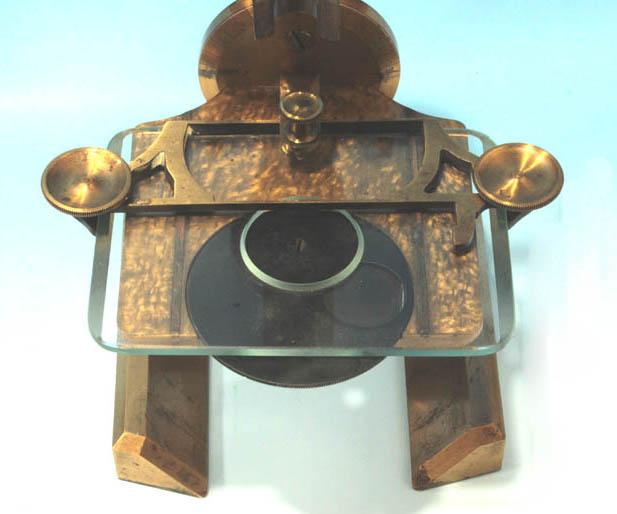
The glide stage has a wheel of 3 apertures built in to the top of the metal portion. The gliding glass portion is held in place by an adjustable tension knob with an ivory tip. This type of stage was invented by Joseph Zentmayer. In use it glides on top of narrow raised parts of the stage, one on each side, reducing friction. The tip of the tensioning knob rides on the portion of the glass inside the brass enclosure. The purpose of the stage is to allow the user to move the slide easily, yet more quickly than a mechanical stage, while the tension on the top of the glass part of the stage allows the slide to to be held steady at any desired location. This is easier to control than simply moving the slide itself on a flat stage. One thing lacking is that there is no slide clip, so the slide simply rests on the edge of the brass.
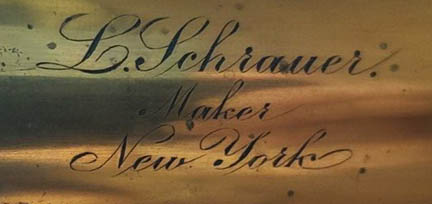 The optical tube is signed in script
 L. Schrauer, Maker, New York
. There is a double nosepiece. Coarse focus is by straight rack and pinion, fine is by a fine screw acting on a long lever inside the limb, activated by a calibrated diamond-pattern knurled knob. There is a draw tube.
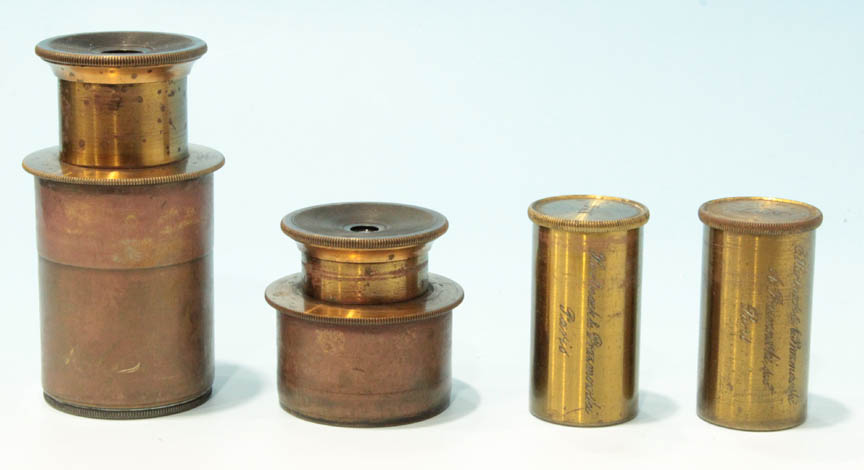
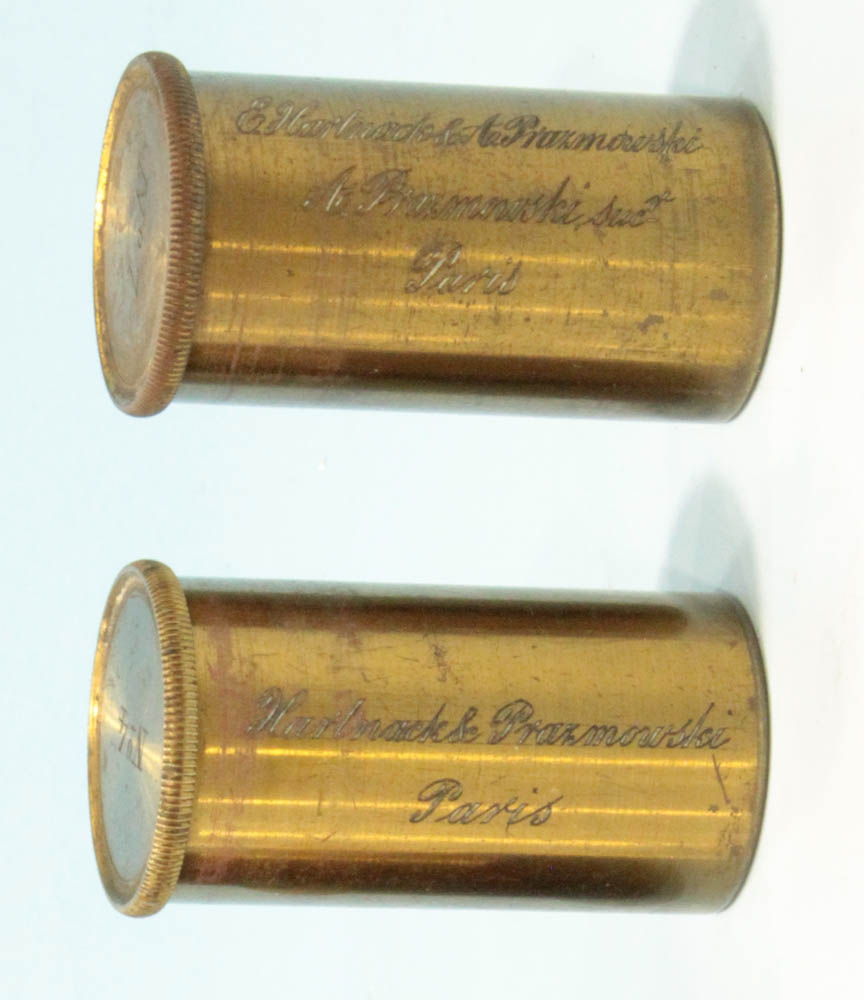
The two French objectives with female threads attach to the nosepiece male threads; this nosepiece has no provision for RMS threaded objectives. The objectives are housed in signed cans. One can is signed E. Hartnack & A. Prazmowski, A. Prazmowski Sucr, Paris
and the other can is signed Hartnack & Prazmowski, Paris
. The lid of one can is engraved No4
and the other is lid is engraved No7
. There are high and low power eyepieces, both unsigned.
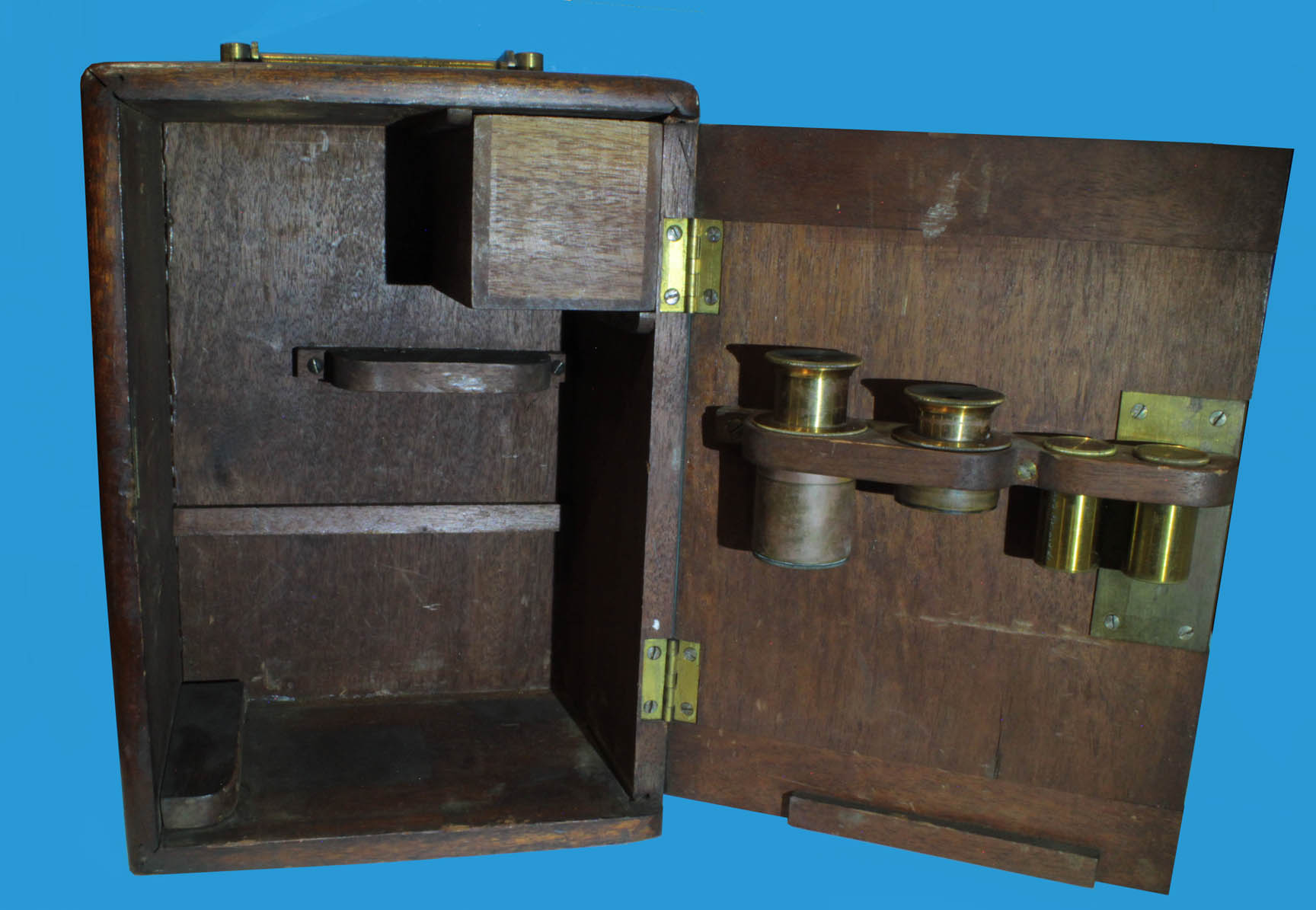
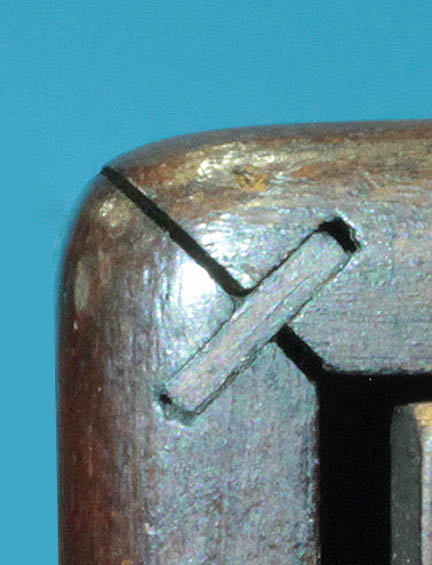
The original case is made of hardwood and has a locking door, the inside surface of which holds the eyepieces and objectives. There is a single drawer in the case. The case corners are joined by splined miter joints.
OPTICAL PROPERTIES*:
The low power objective has a N.A. of about 0.3 and the high power objective has an N.A. 0.63. There is little if any chromatic aberration and mild spherical aberration. The fields are relatively flat. The magnification of the combination of the lower power eyepiece and the low power objective is about 100X and with the high power objective about 200X.
*N.A. was measured with a Beck apertometer. Magnification was measured with a Wright Eikenometer. Chromatic and spherical aberration were judged using a Barone aberration test slide by Diatom Shop.
CONDITION:
The overall condition of this microscope is very good. Particularly attractive is the decorative metal stage surface. The screw that holds the mirror gimbal to its mount is a suitable brass replacement. The lacquer is well preserved overall, though there are scattered losses, more severe on the foot. All controls and functions work very well and it is optically good as well. The case is complete but has cracks as would be expected and some damage to the finish, especially on the outside of the door. The splined miter joints are intact, but were a poor choice for this purpose, and are separating, likely to come apart at some point. Dovetail joinery would have been a better choice for the stress of a heavy microscope; I would not hold this case by the handle if the microscope was inside it! The key for the lock is lacking.
HISTORY:
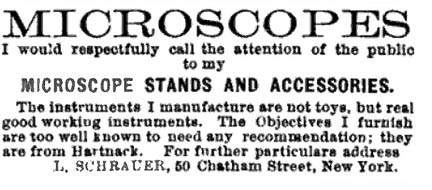 Leopold Schrauer was a maker of microscopes and other apparatus in the last quarter of the 19th century. He started working in Boston but was working in New York City starting no later than 1876, as shown by the ad from the American Journal of Microscopy and Popular Science of that year to the left. He worked in New York into the 1890's. He made the stands and accessories, but did not make the objectives, instead supplying those by Hartnack & Prazmowski or Prazmowski, successor to Hartnack & Prazmowski, and also at times by William Wales. In 1878 he introduced a binocular model, and a
 new
double nosepiece. In 1879 he was at 42 Nassau Street when he introduced his New Universal
model, priced at $50 and furnished with W. Wales objectives. Only one Illustrated price list (from 1878) is known as of the time of this writing(October, 2022). Despite many different examples of his work, I have only found labeled illustrations identifying models in the 1878 price list, and the illustration in Behrens. The following table lists his known addresses.
| ADDRESS | YEARS KNOWN |
|---|
| 13 Edgerly Place, Boston | ? to 1875 |
| 50 Chatham Street, N.Y. | 1876 to 1877 |
| 42 & 44 Nassau Street, N.Y. | 1878 to 1879 |
| 228 E 34th Street, N.Y. | 1881 |
Although the number of stands produced by Schrauer is not known, It is clear that he made several examples of a few standard models and also several others which were made in very limited quantities. In fact, several models either signed or attributed to him are recognized because of only one known surviving example, and the model names Schrauer gave to most of these rare microscopes is unknown at the time of this writing (October, 2022).
EARLY SCHRAUER MICROSCOPES FROM BOSTON:
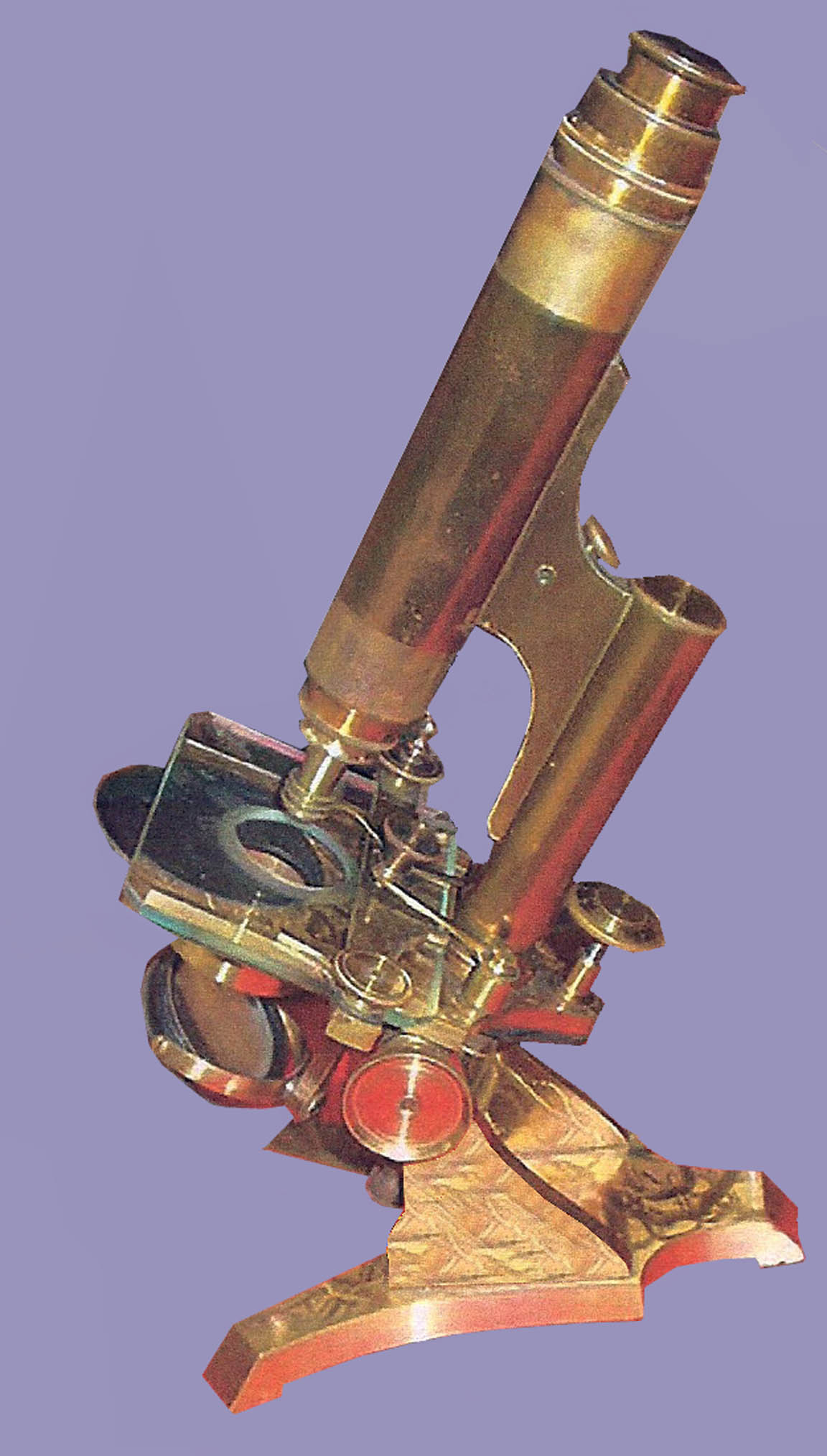
This is a Schrauer microscope signed on the main tube L. Schrauer, Boston
, dating it to prior to 1876. It is nearly identical to the earliest known form of Schrauer's Physicians' microscope though it lacks the rack and pinion coarse focus of that model. Except for the decorative surface finish, it has a foot and uprights closely resembling those on known Tolles Student stands of the same period from the same city.
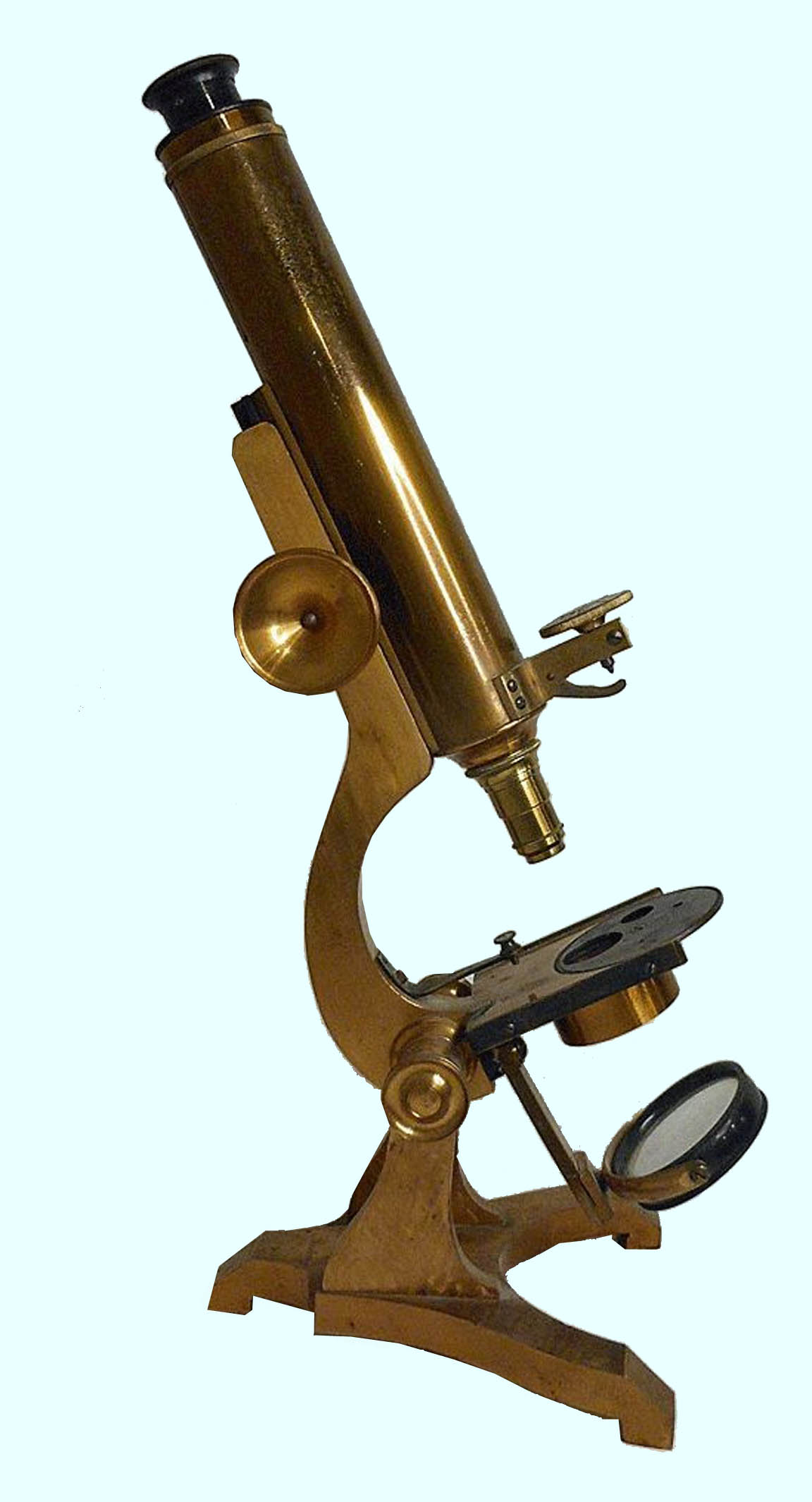
This Schrauer microscope is signed on the foot L. Schrauer, Boston
. It has a rack and pinion coarse, and nosepiece fine focus. There is a ring attached to the bottom of the stage to accept accessories. Like many Schrauer microscopes found today, it is missing its glass glide stage.
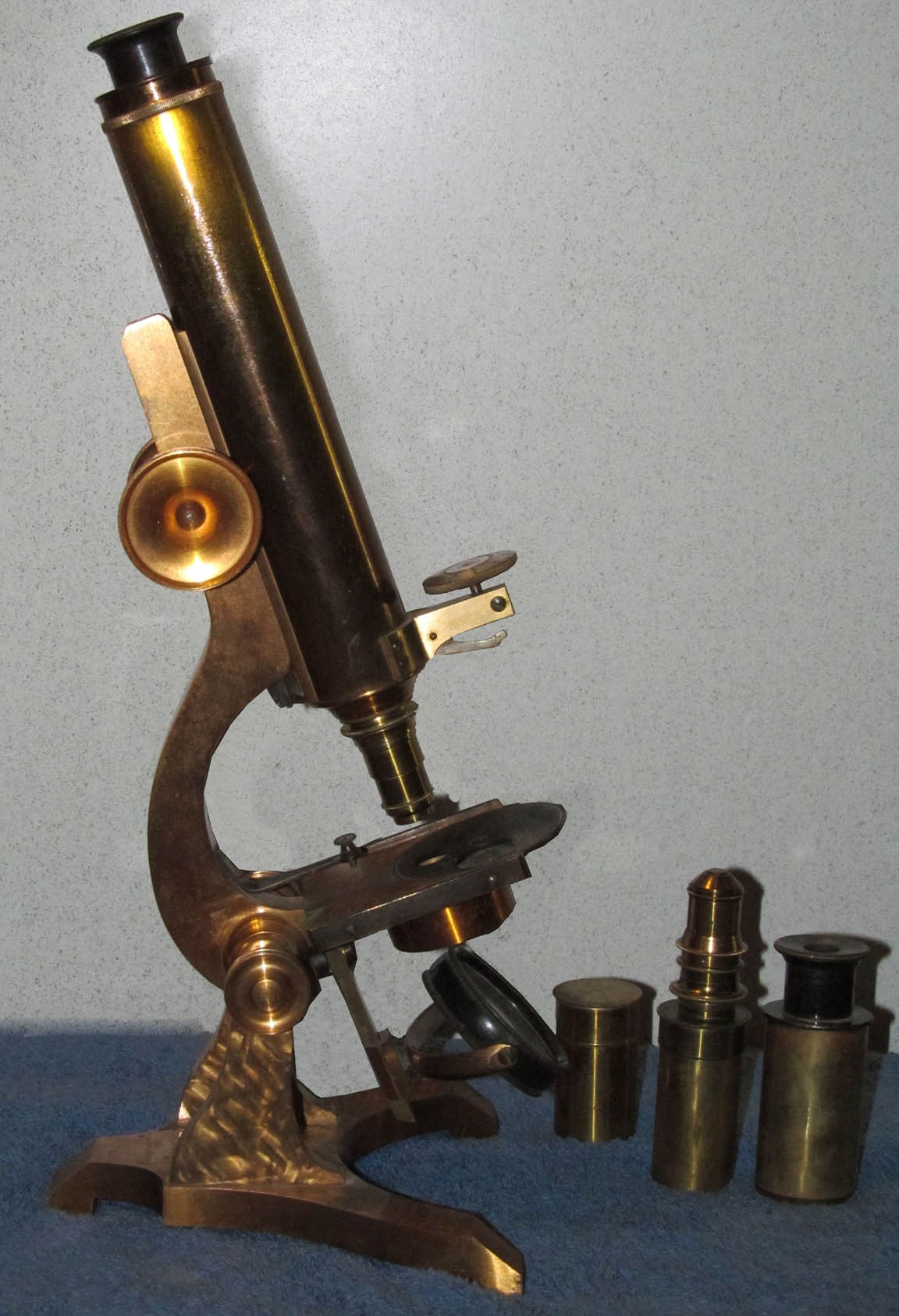
This Schrauer likely dates to before 1878. It has a Ross-type foot and flat plate uprights, with a nosepiece fine focus, like some of Schrauer's known Boston stands, but not used on later Schrauer microscopes
SCHRAUER MICROSCOPES FROM NEW YORK CITY, 1876 ONWARD:
Shown below, from Schrauer's Illustrated Price List of 1878 are four models. These include the earlier version of the Physician's Model, the newly released (2nd version) of the Physician's model, which was also illustrated in Behrens book, The Microscope in Botany of 1885, the Laboratory Model, and the Student Microscope.
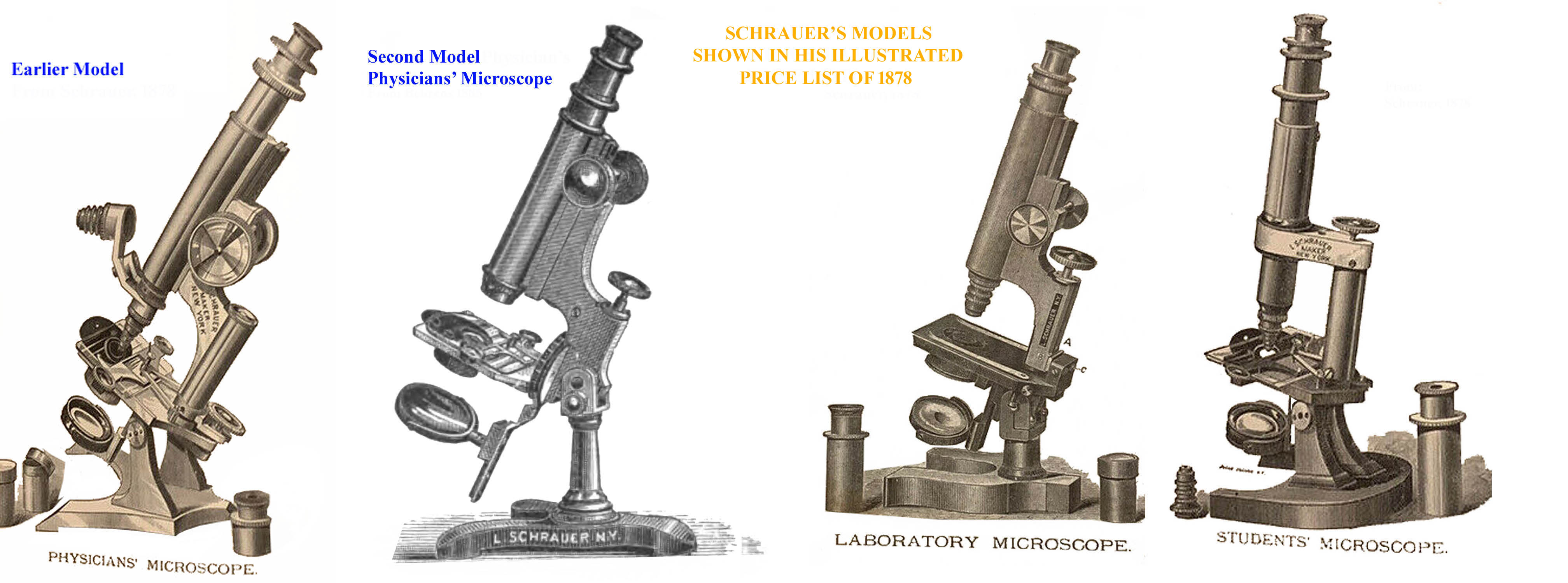
Note that the earlier physicians' model had a Ross-type foot with flat uprights, and a tilting stage fine focus. The new version of the Physicians' model had a long-lever fine focus and arises from a more American-looking Y-shaped foot with a single pillar topped by a U-shaped fitting for inclination, similar to several of Walter Bulloch's models. The laboratory microscope inclines on a short pillar, has rack and pinion coarse focus, and has a Continental style fine focus with a plane stage and a lyre-shaped foot. The student microscope was erected on a U-shaped foot , had push-pull coarse focus, and what appears to also be a Continental-style fine focus.
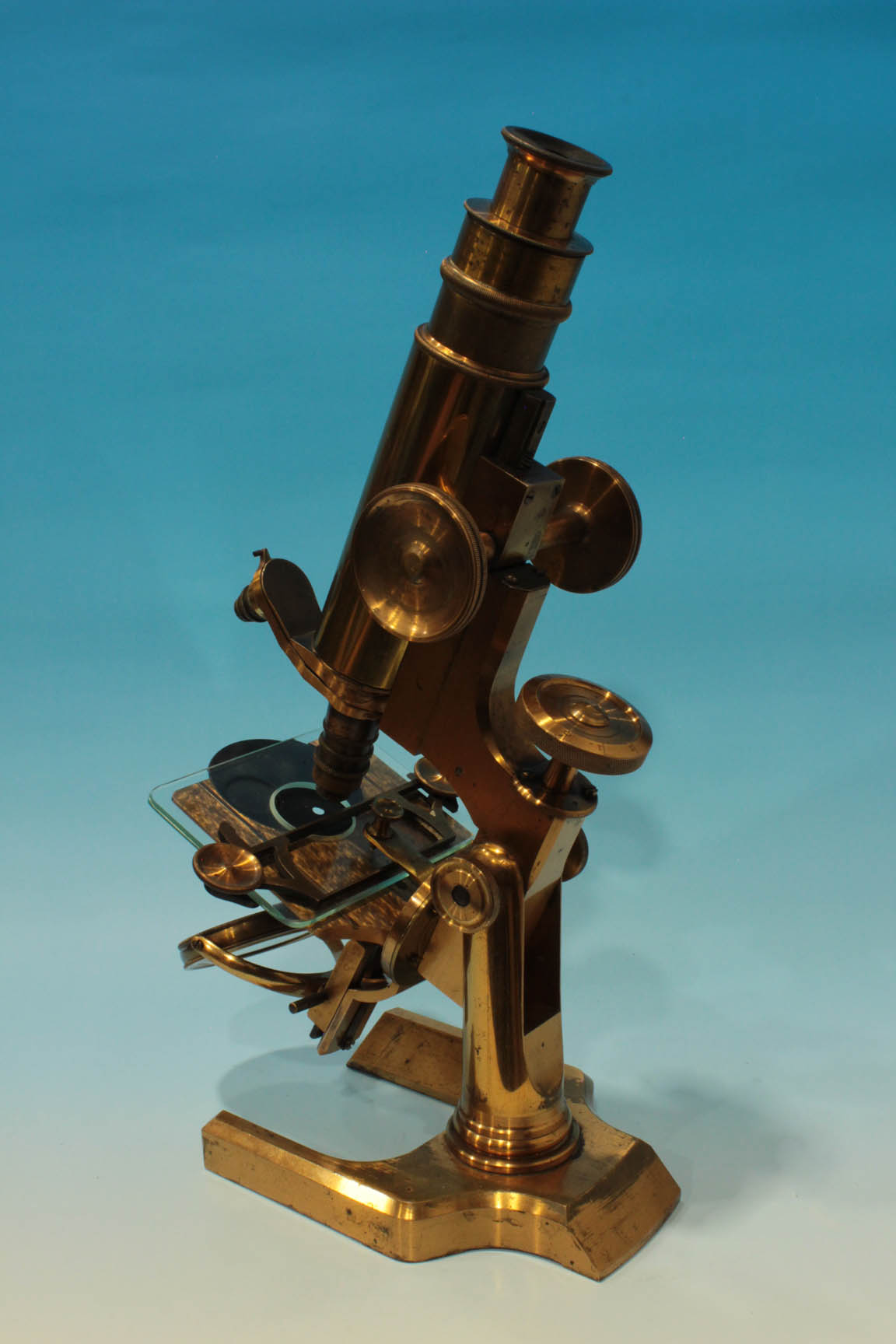 My microscope is very similar to the second version of the physician's microscope except for the later design of the foot, and the top of the pillar, hence this is likely the third version of the Physician's Model. Later examples of the same microscope have a rack and pinion substage with a condenser mount, and hence may constitute a fourth version of the Physicians' stand or they may be his
 Universal
model.
Please note that among the entries that follow, those marked with an asterisk* are from Allan Wissner's collection, and the images are used by permission. Clicking on those images will take you to Allan's site with more images of the example shown.
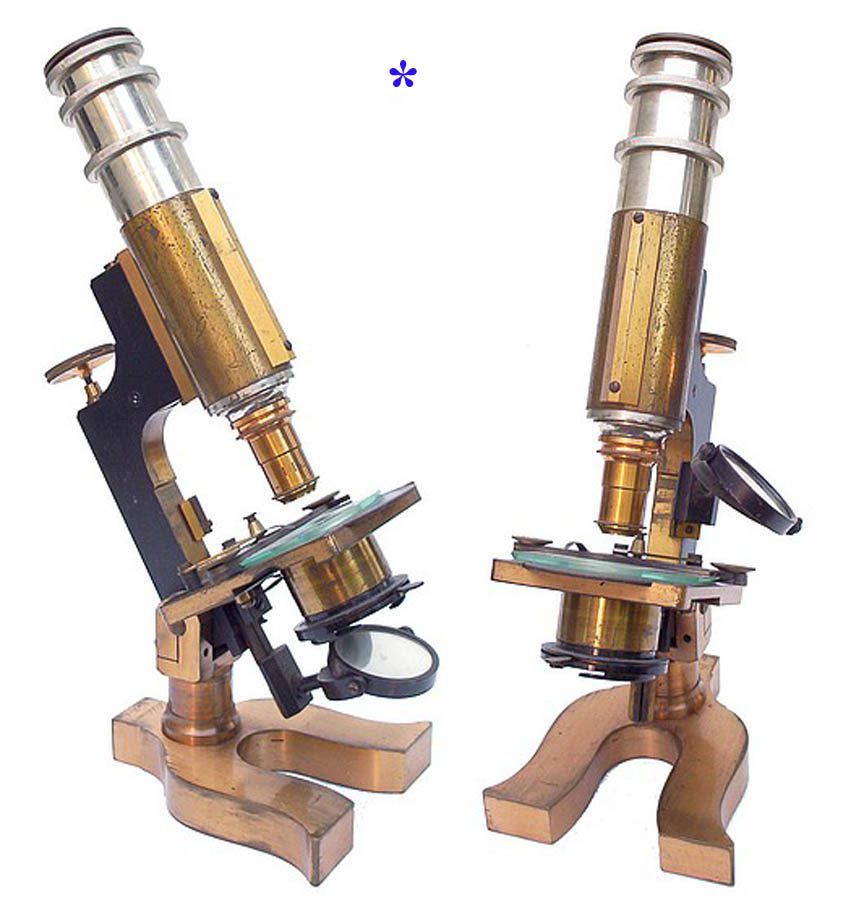
*This microscope, probably dating to the 1870s, is at the time of this writing (October 2022), the only known example of this model.
Instead of a swinging substage, this example has a mounting on the limb to allow the mirror after being removed from the tailpiece, to be setup on the limb for top-illumination of opaque objects. This is much easier and cheaper to make than a swinging substage. It has push-pull coarse focusing and long-lever fine focusing. It sits on a lyre-shaped foot*.
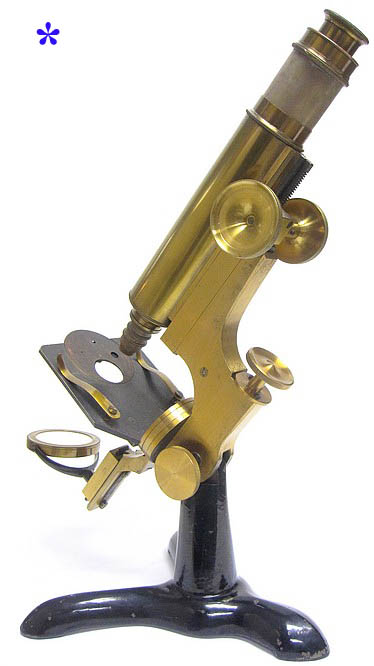
This microscope is unsigned but is essentially a Physicians' model with a plain stage with stage clips instead of the glide stage*.
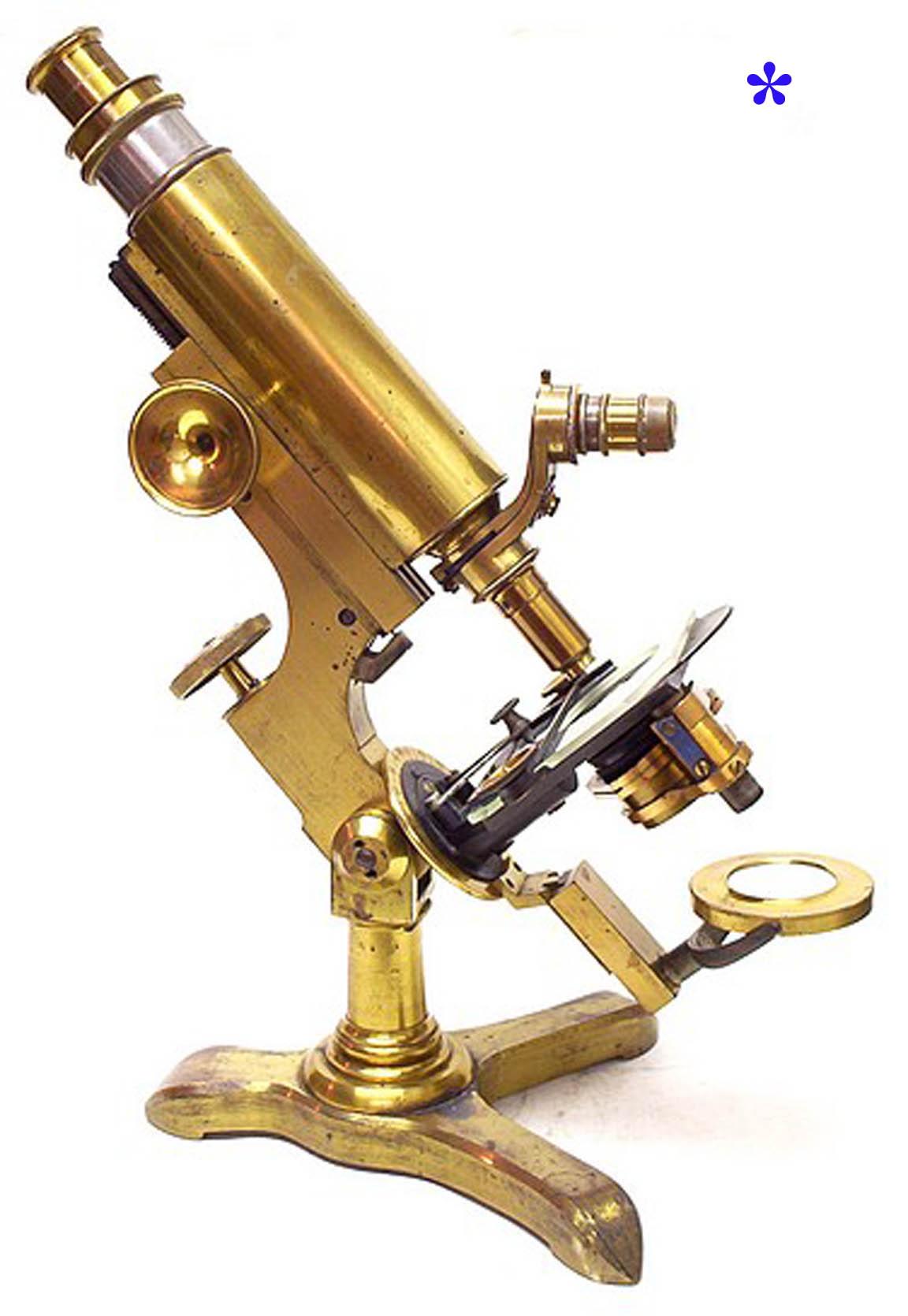
This Physicians' model is very similar to the model shown in the 1878 catalog, but a condenser mount is attached to the bottom of the stage and can swivel in and out of the optical axis*.
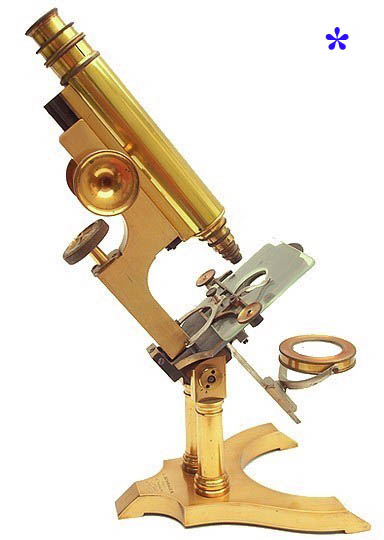
This microscope, which is somewhat similar to the Physicians' microscopes noted above, but has a thinner longer limb, double pillar, a different tailpiece, and different foot. It retains the long lever fine focus from within the limb but does not have a swinging tailpiece that can rotate above the stage. This microscope, with the address of 42 Nassau street included in the signature can be accurately dated by its address to between 1878 and 1880.*
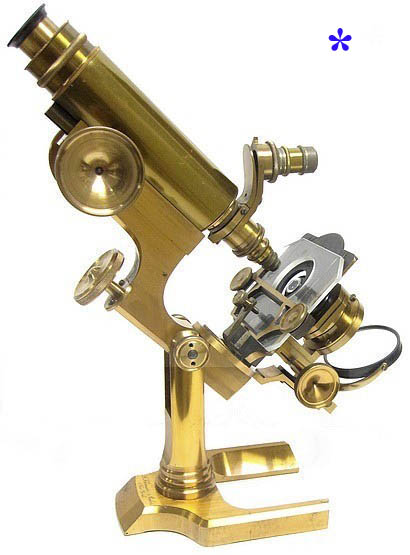
Another example, similar to the others except for the addition of a rack and pinion substage attached to the tailpiece and carrying a condenser*.
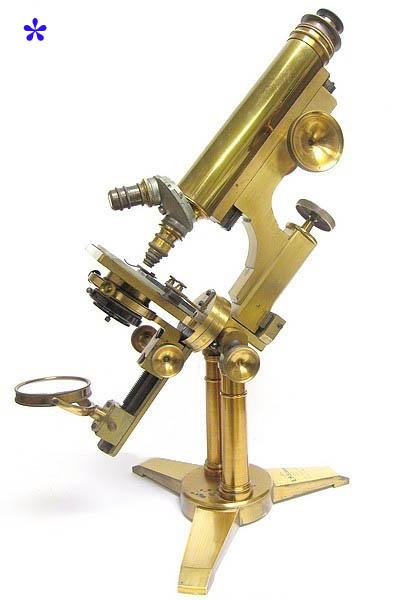
This is a first class
microscope by Schrauer. It is the largest of his known models, and likely the top of his line. Its address at 42 Nassau street dates it to 1878-1880. It sits on an American-type flattened tripod and is supported by two pillars. The coarse focus is by rack and pinion and the fine by long lever. Its swinging substage tailpiece carries a rack and pinion-focused ring with two centering screws. The plain and concave gimbaled mirror rides on a dovetail joint on the same tailpiece. Unlike his lesser models, the rotating ring of the swinging substage is engraved in fine calibrations. The glide stage has two tension knobs and there is a single stage clip. The microscope can rotate on its tripod but there are no calbrations for this motion. This microscope closely resembles first class microscopes by other makers such as Zentmayer, Bulloch, and Tolles. With a few exceptions, first class microscopes of most makers were too expensive for most and so they were made in relatively small numbers. In fact, this is the only known example of this model as of the date of this writing (October, 2022)*.
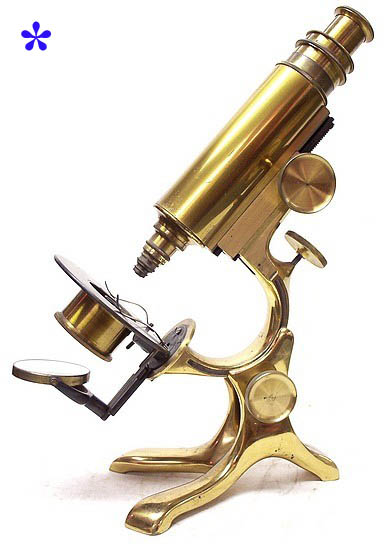
This microscope, though unsigned can be attributed to Schrauer because of many of its features. It is Schrauer's version of a Wale limb microscope, invented by George Wale and first offered by Wale in 1878. Schrauer's version, reported in the Amer Mon Micro Journal of 1882 was also referred to as Schrauer's portable
microscope because the foot was easily removed and the whole microscope could be packed flat between clothes in a suitcase*.
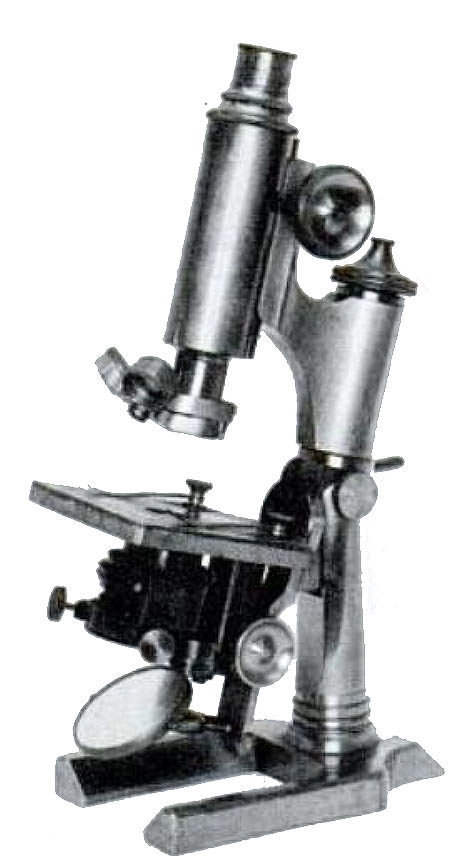
Another example with continental-style fine focusing. The example here is from the Billings Collection of the Armed Forces Institute of Pathology Museum in Washington, D.C., catalog figure 195. It has a swinging tailpiece, and a rack and pinion substage with centering screws and an Abbe-type condenser. This microscope, although signed, has no address. The angled profile foot, probably dates it to before 1889. This is the only Schrauer microscope in the Billings Collection.
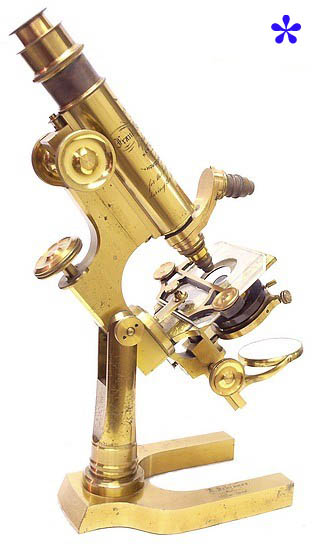
This microscope, awarded to the valedictorian of a medical school class in 1889, is virtually identical to the prior entry, except for fact that the profile of the foot is squared off rather than angled inward.*

*This microscope, awarded as second prize to a student of the medical school class in 1894, has a thiner limb with a fast and slow
fine focus knob. The thinner projection on the top of the knob allows a more rapid motion than the larger diameter portion. It has a plain stage with clips, and has a ring attached to the bottom of the stage to accept accessories such as an aperture holder (shown). Again, the foot is squared off*.
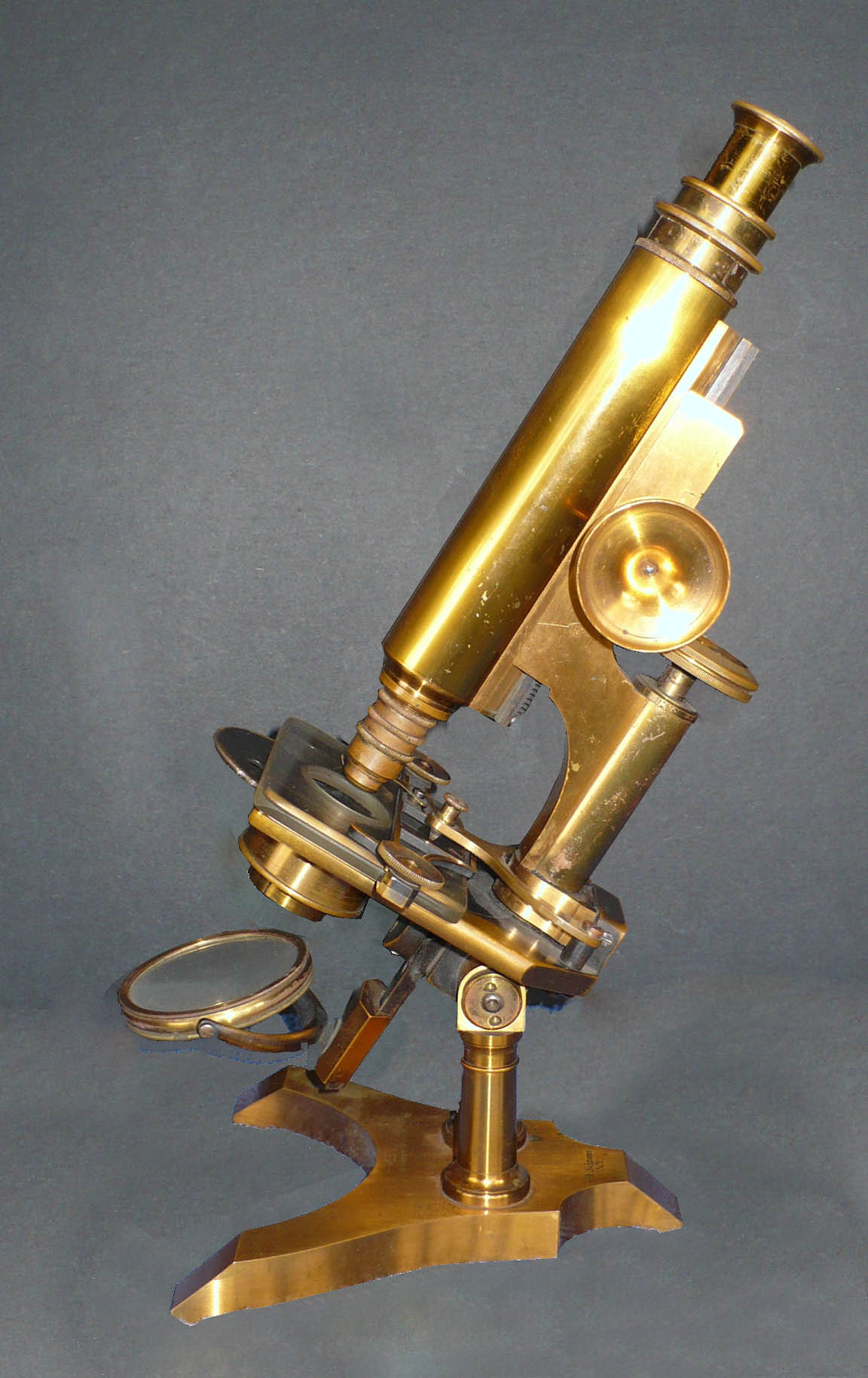
Although his microscopes often resembled continental models, Schrauer made many microscopes that, though they superficially resembled the continental form, had a long lever fine focus rather than the continental type of fine focus arrangement. As noted above in the 1878 Catalog however, Schrauer did make actual continental limb microscopes with the continental type of fine focusing. This is a double-pillar example. The focusing mechanism worked by adjusting the height of the limb via a knob controlling the spring-loaded vertical movement of the entire limb on the stage. Its dating is unclear.
*The author is grateful to Allan Wissner for his kindness in allowing us to use many of his images of his Schrauer microscopes on this page. Clicking on his images will take you to his pages about those microscopes.